The Life Experience Checklist
Check off what applies to you. There’s no right answer — this is just a fun way to reflect on your experiences so far. Nothing is saved or shared.
You can leave items unchecked — every result is normal.
—
The Rice Purity Test has grown from a single Rice University orientation-week tradition into one of the most widely shared self-reflection quizzes on the internet. Below, we cover everything you need to know: what the test is, how scoring works, what your number really means, and answers to the questions people ask most.
Whether you found this page through a friend's shared score, a search for "what does my purity score mean," or simple curiosity about where the test came from, this guide is built to answer it all in one place. We've organized it using the table of contents above, so feel free to jump straight to the section that matters most to you, or read through from the top for the full picture — from the test's college-campus origins to how modern, browser-based versions like this one keep your results completely private.
01Take the Rice Purity Test
If you haven't taken the quiz yet, scroll up to the interactive tool at the top of this page. It walks you through the checklist one question at a time, your score updates live as you go, and your results are never saved, stored, or shared with anyone — everything happens in your browser.
There's no time limit, no account required, and no "wrong" way to take it. Answer honestly, at your own pace, and remember that this is meant to be a light-hearted look back at your experiences so far, not a test you can pass or fail.
Taking it online rather than on paper has a few practical advantages over the original printed checklist students used decades ago. The score calculates itself instantly instead of requiring manual counting, the live gauge lets you see the effect of each answer in real time, and because nothing is written down or submitted anywhere, there's no physical copy for anyone else to stumble across later. It keeps the spirit of the original icebreaker activity while removing the friction — and the paper trail — that came with it.
02What Is the Rice Purity Test?
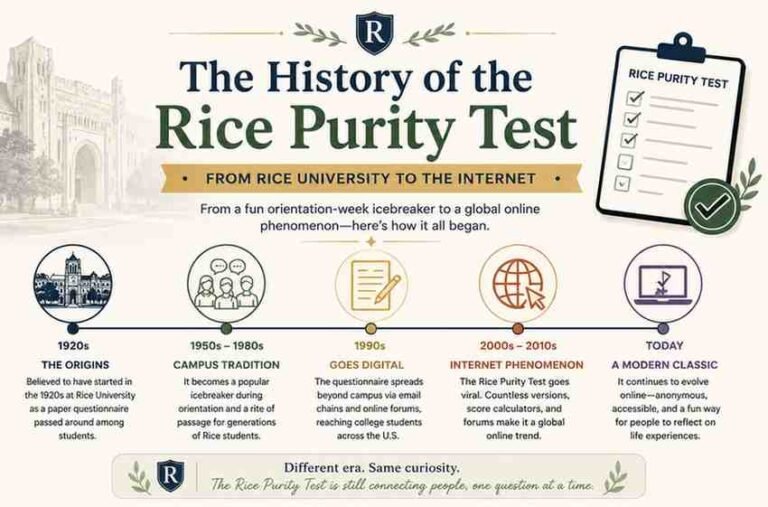
The Rice Purity Test is a self-assessment questionnaire that originated at Rice University in the 1920s as an orientation-week icebreaker. The idea was simple: give incoming students a lighthearted, judgment-free way to compare notes on the everyday milestones of growing up, and use it as a conversation starter during O-Week.
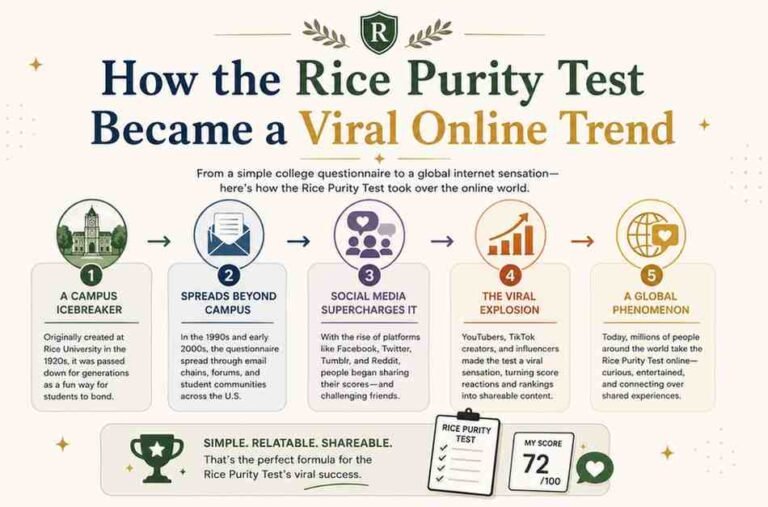
Over the following decades, the checklist was rewritten many times by different student groups, eventually settling into the familiar 100-item format that spread to other campuses in the 1980s. Once the test moved online, it stopped being a campus-only tradition and became a broader internet phenomenon — taken today by students, teens, and adults all over the world, usually just for fun with friends.
It's worth being clear about what the test isn't. It is not a clinical instrument, it isn't affiliated with any psychology department, and it doesn't produce a scientifically validated result. It's best understood the way you'd understand a magazine personality quiz: entertaining, personal, and not something to take too seriously.
The reason the format has lasted so long comes down to how it was originally used. During orientation week, small groups of new students — often strangers just days into meeting each other — needed a low-stakes way to break the ice. A checklist that people could go through together, laugh about, and compare turned out to be far more effective than a typical "get to know you" conversation. That same social function is a big part of why the test still gets shared in dorm rooms, group chats, and social media threads today: it gives people something shared and low-pressure to talk about.
By the time the test had spread to other universities in the 1980s, it had already been rewritten and reorganized many times by different student groups, which is part of why slightly different versions still circulate today. The move online in the 2000s and 2010s changed its audience dramatically — instead of being tied to a single campus tradition, it became something anyone with an internet connection could take, whether or not they had any connection to Rice University at all.
03How Does It Work?
The mechanics are straightforward. You're presented with a series of statements describing common life experiences — things related to independence, relationships, social life, travel, and personal milestones. For each one, you simply indicate whether it applies to you.
- Read each item and decide honestly whether it describes something you've done.
- Answer at your own pace — there's no timer and no pressure to rush.
- Watch your score adjust as you go, so you can see exactly how each answer affects the result.
- Review your final score once you've gone through every item, along with a short description of what your range typically means.
Each item you check off nudges your score down slightly, since the test is measuring how many listed experiences you've had, not how "good" or "bad" any individual answer is. There's no ranking, leaderboard, or comparison built into the tool itself — anything you choose to share afterward is entirely up to you.
A few tips that make the process smoother:
- Don't overthink borderline cases. If a question is close, go with your first instinct rather than agonizing over technicalities.
- Take it somewhere you can focus, even for just the few minutes it takes, so your answers reflect your actual experiences rather than a rushed guess.
- Remember you can revisit answers. If you realize partway through that an earlier answer wasn't quite right, the back option lets you correct it.
- There's no need to finish in one sitting — since nothing is saved between visits, just keep in mind you'll start over if you leave and come back later.
04What Your Score Means
Your final Rice Purity Test score is simply a number between 0 and 100 that reflects how many of the listed experiences apply to you. It is not a moral judgment, a measure of maturity, or a prediction about your future — it's a snapshot of where things stand today.
Because everyone's life unfolds on a different timeline, two people the same age can land on very different scores and both be completely normal. Culture, upbringing, personality, and simple timing all shape the result far more than any single factor.
- A higher score generally means fewer of the listed experiences have happened yet.
- A lower score generally means more of them have.
Neither direction is better. Some people take the test once for curiosity and never think about it again; others enjoy retaking it every year or two to see how their answers have shifted. Both approaches are fine — the test exists purely for reflection and fun.
To put it in perspective: imagine two people in the same friend group, both in their early twenties, taking the test on the same day. One scores 82, the other scores 51. On paper that's a large gap, but it usually just reflects different life paths — one may have moved away for school while the other stayed close to home, one may have started working earlier, or they may simply have different comfort levels with certain kinds of experiences. Neither number says anything about who is more responsible, more interesting, or more "mature." It's a snapshot of experience, not a report card.
05Score Ranges Explained
To make results easier to interpret, most versions of the test group scores into five broad bands. These are informal descriptions, not strict categories, so treat them as a rough guide rather than a verdict.
| Score Range | General Label | What It Usually Suggests |
|---|---|---|
| 90 – 100 | Very Reserved | Very few of the listed experiences have happened yet — plenty still ahead. |
| 70 – 89 | Mildly Adventurous | A handful of experiences checked off, while keeping a fairly cautious pace overall. |
| 40 – 69 | Well-Rounded | A balanced mix — a lot of everyday milestones, some bigger ones too. |
| 20 – 39 | Very Experienced | Most of the listed experiences apply, suggesting an eventful few years. |
| 0 – 19 | Extremely Experienced | Nearly everything on the list applies — a genuinely full and varied history. |
These ranges exist purely to add a bit of color to your number — they don't define your character, your values, or your worth, and there's no "target" range you should be aiming for. If your score lands right on the edge between two bands, that's not a meaningful distinction either; a 69 and a 71 reflect almost identical amounts of experience, even though they technically fall into different labeled ranges. Treat the bands as loose descriptions, not hard boundaries.
06What's the Average Score?
There's no official, scientifically tracked average for the Rice Purity Test — it isn't administered as a formal study, so any figures you see online are based on informal, self-reported results rather than rigorous research. That said, based on commonly shared results, most people land somewhere in the middle of the scale.
It's also important to remember that any "average" is skewed by who happens to take the test and choose to share it. People who enjoy comparing scores with friends, or who post results on social media, aren't a random sample of the population — they tend to be younger, more online, and more socially active than average, which naturally shifts the numbers you see cited around the web. Use the ranges below as a loose point of reference, not a statistically rigorous benchmark.
| Age Group | Commonly Reported Range |
|---|---|
| Teens (15–17) | 70 – 85 |
| Young adults (18–22) | 60 – 75 |
| Adults (23+) | 45 – 65 |
Treat these figures as general context, not a benchmark. Lifestyle, culture, personal circumstances, and simple chance affect your score far more than your age bracket does, and it's completely normal to fall well outside these ranges in either direction. If your score doesn't match the "typical" range for your age group, that's not unusual — these figures describe a broad trend across many different people, not a rule that applies to any one individual.
07Is a Higher or Lower Score Better?
Neither. This is one of the most common misconceptions about the test, so it's worth stating plainly: there is no "good" or "bad" Rice Purity Test score.
A high score simply means fewer of the listed experiences have happened so far — often because of age, personal choice, opportunity, or comfort level, and sometimes for no particular reason at all. A low score means the opposite. Neither outcome says anything meaningful about someone's intelligence, character, or the choices they'll make going forward.
It's also worth remembering that the test only captures a fixed, dated list of experiences. It can't capture the countless other things that make up a person's life, so it was never designed to be a complete picture — just a fun, partial snapshot.
Some people also assume a high score means someone is "behind" or a low score means someone has been reckless — neither assumption holds up. A high score might simply reflect someone who's been focused on school, a career, or a family situation that hasn't left room for certain experiences yet. A low score might reflect someone who's traveled a lot, moved out early, or simply had more opportunities cross their path. Context always matters more than the number itself.
08Is It Anonymous and Safe?
Yes. This tool is built to be completely anonymous:
- No account or sign-up is required to take the test.
- No personal information is collected at any point.
- Your answers and score are not saved on our servers or shared with anyone.
- Everything happens locally in your browser — closing or refreshing the page clears it.
You're always in control of whether you share your result with anyone else. If you'd rather keep your score to yourself, nothing about how the tool works requires you to share it.
From a technical standpoint, the quiz tool doesn't set tracking cookies, doesn't send your answers to any server, and doesn't use any third-party analytics to record individual responses. Your progress and score exist only in your device's memory for the duration of your visit. This site may use standard, general-purpose tools like Google Analytics or Google AdSense to understand overall traffic and display ads, the same way most websites do — but none of that is connected to your quiz answers in any way.
09Different Versions of the Test
Because the original Rice Purity Test has been around for so long, fan communities have created dozens of themed spin-offs over the years. These unofficial versions swap the original questions for ones tied to a specific interest, while keeping the same basic "check what applies to you" format.
This kind of remixing is common with long-running internet quiz formats — once a structure becomes recognizable, communities naturally adapt it to their own interests rather than starting from scratch. It's part of why the Rice Purity format specifically has stayed relevant for so long: the scoring mechanic is simple enough to reuse for almost any topic, from hobbies to fandoms to entirely unrelated interests, while still feeling familiar to anyone who's taken a version of it before.
| Themed Version | Focus |
|---|---|
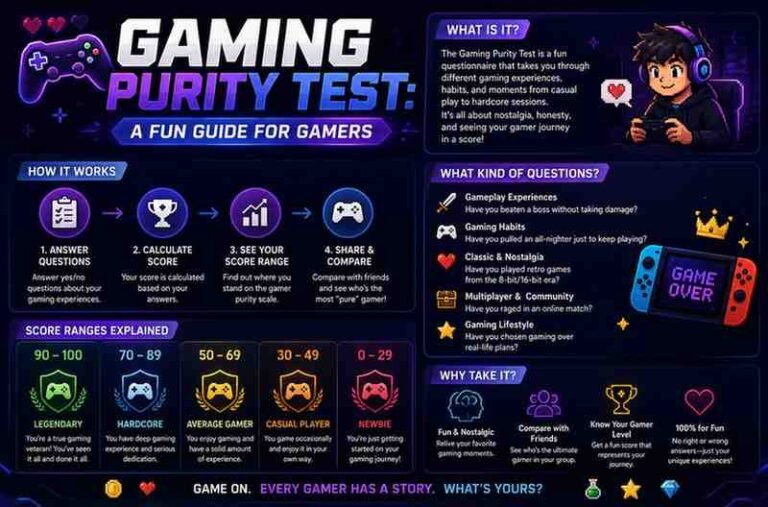
| Gaming Edition | Online games, multiplayer habits, and player culture |
| Anime Edition | Anime and fandom-related experiences |
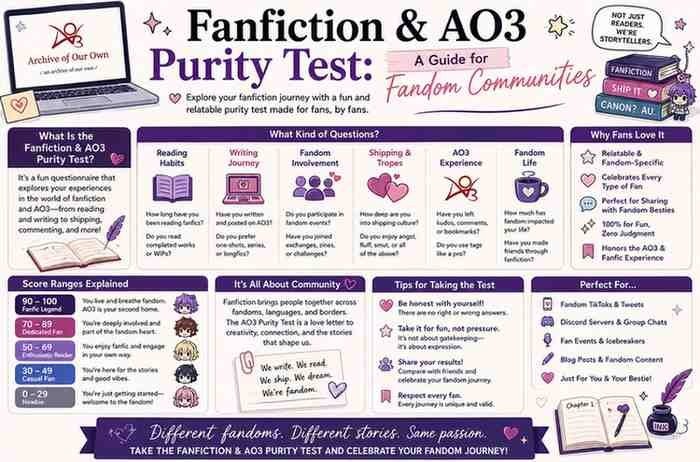
| Fanfiction / AO3 Edition | Reading and writing fan fiction communities |
| Music & Concert Edition | Festivals, concerts, and music fandom |
None of these fan-made spin-offs are officially connected to Rice University — they're community projects built purely for fun. The original 100-question format remains the version most people recognize and compare scores on, which is why it's still the most widely shared today.
10Popularity by Country
Although it started on a single U.S. campus, the Rice Purity Test now has an international audience. Search and social-sharing trends suggest the largest groups of participants come from the United States, Canada, and the United Kingdom, with strong pockets of interest in Australia, Germany, Italy, and the Philippines as well.
| Region | Typical Audience |
|---|---|
| United States & Canada | College students and young adults, often shared during orientation season |
| United Kingdom & Australia | Students and social-media users, often via group comparisons |
| Germany & Italy | Younger audiences discovering it through viral social posts |
| Philippines | Broad youth engagement via online quiz culture |
Wherever it's taken, the purpose stays the same everywhere: a quick, judgment-free way to reflect on your own experiences and, if you want to, compare notes with friends.
The test's global spread mirrors the broader rise of shareable online quizzes more generally. Mobile browsing made it easy to take a quiz in a few spare minutes, and social platforms made it just as easy to post a result and invite friends to compare theirs. A format built for a single orientation week in Texas turned out to translate well across languages and cultures precisely because its core idea — reflecting on your own experiences, without judgment — doesn't need much adaptation to make sense anywhere.
11Frequently Asked Questions
What is a good Rice Purity Test score?
How is the Rice Purity Test score calculated?
Is the Rice Purity Test scientifically accurate?
Is the Rice Purity Test appropriate for teens?
Can I retake the Rice Purity Test?
Does the Rice Purity Test save or share my answers?
Why is it called the "Rice" Purity Test?
Is a lower score something to worry about?
What's the difference between this and other purity tests online?
Do I need to answer every question honestly?
How long does the Rice Purity Test take to complete?
Is there an official Rice University version of this test?
Can I compare my score with friends?
Does a low score mean something is wrong?
-
Fanfiction & AO3 Purity Test: A Guide for Fandom Communities
What Is the Fanfiction Purity Test? The Fanfiction Purity Test — sometimes called the AO3 Purity Test, after the popular…
-
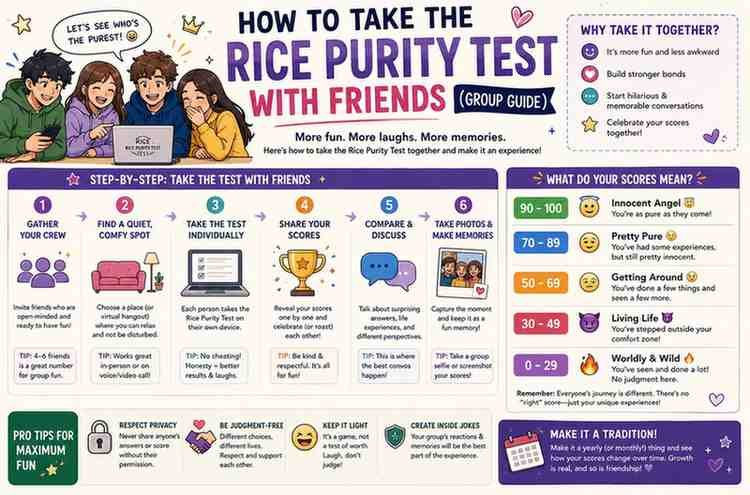
How to Take the Rice Purity Test with Friends (Group Guide)
Why People Take It in Groups Although the Rice Purity Test can be taken alone out of curiosity, it’s most commonly enjoyed…
-
Gaming Purity Test: A Fun Guide for Gamers 2026
What Is the Gaming Purity Test? The Gaming Purity Test is another community-built spin-off of the original Rice Purity Test, this…
-
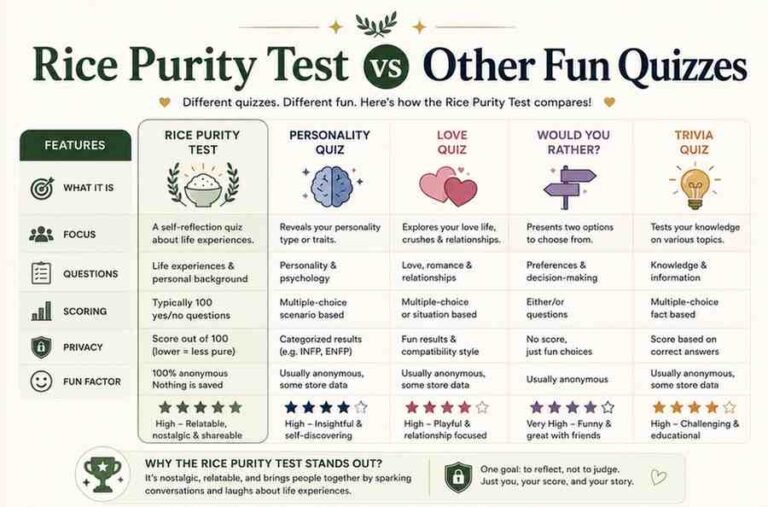
Rice Purity Test vs Other Fun Quizzes: Key Differences Explained
What Makes a Quiz “Fun” Online The internet is full of quiz formats — personality tests, trivia challenges, “which character…
-
The History of the Rice Purity Test: From Rice University to the Internet
Where the Test Began Long before it became a link shared in group chats, the Rice Purity Test started as…
-
How the Rice Purity Test Became a Viral Online Trend 2026
From Campus Tradition to Internet Quiz The Rice Purity Test spent decades as a strictly campus-bound tradition before it ever…